
Bringing UT’s Turfgrass Expertise to FIFA World Cup 26


Stadium images taken before FIFA Club World Cup 2025
Tackling turfgrass
What does it take to create the best pitches for FIFA World Cup 26™?


The University of Tennessee, Knoxville’s world-renowned turfgrass experts are leading a first-of-its-kind research collaboration with Michigan State University and FIFA, the global governing body for soccer, to set the stage for the world’s biggest and most-watched sporting event—FIFA World Cup 26 for some of the world’s top athletes.
UT is heading up the installation, testing, and maintenance of natural turfgrass at 16 stadiums and dozens of training facilities across Canada, Mexico, and the United States. The goal is to ensure safe and consistent fields of play.
Explore the stadiums
With locations in three countries across multiple climate zones, the 16 stadiums that will host FIFA World Cup 26 matches present varied scientific challenges for UT’s team of experts.
Choose a stadium to learn more about the turfgrass developed and installed for that pitch.
- BC Place Vancouver, Canada
- Toronto Stadium, Canada
- Estadio Azteca Mexico City, Mexico
- Estadio Guadalajara, Mexico
- Estadio Monterrey, Mexico
- Atlanta Stadium, USA
- Boston Stadium, USA
- Dallas Stadium, USA
- Houston Stadium, USA
- Kansas City Stadium, USA
- Los Angeles Stadium, USA
- Miami Stadium, USA
- New York New Jersey Stadium, USA
- Philadelphia Stadium, USA
- San Francisco Bay Area Stadium, USA
- Seattle Stadium, USA
Championship stadium


Delve into the pitch
How can a soccer ball bounce the same on a pitch in Vancouver, Canada, and in Mexico City? Through a five-year research project, UT’s expert turfgrass team has been developing turfgrass systems along with irrigation, maintenance, and testing methods to produce identical pitches that are safe for players.
Two of these systems include conventional rootzone and shallow profile. Conventional rootzone systems are typically found beneath high-end, natural turf fields. But eight of the sixteen stadiums hosting the World Cup are designed for artificial turf—and FIFA only uses natural turf. That’s where the shallow profile system comes in. Instead of a gravel base layer used in the conventional rootzone system, the shallow profile system uses permavoid and geotextile materials.
Select a layer to learn how the pieces of each turfgrass system work together.
Both Turfgrass Systems
Sod
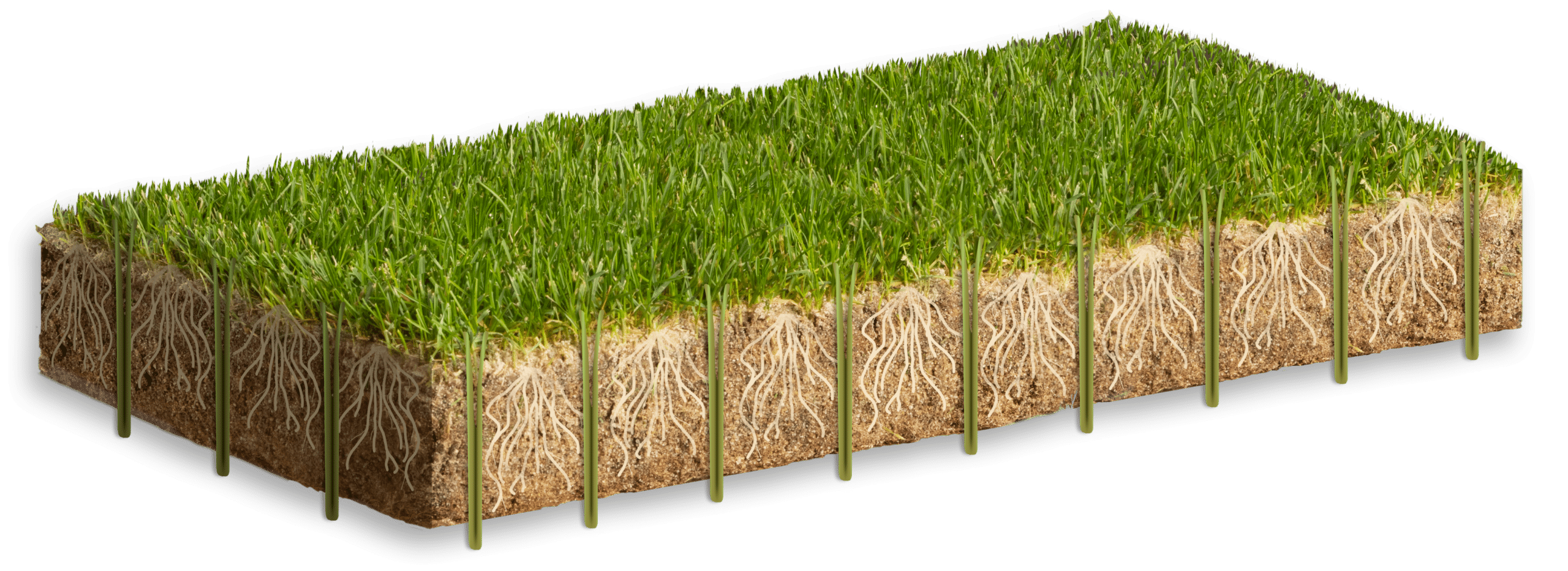
Sod is the top layer of both turfgrass systems. The turf itself is bermudagrass (for warmer climates) or a mix of Kentucky bluegrass and perennial ryegrass (for cooler climates).
A method known as hybrid stitching provides additional stability by reinforcing the pitch with fibers. The rod method of stitching, used for most outdoor stadiums and some indoor stadiums, injects reinforcing fibers into the soil as the grass grows. Some pitches for both domed and one outdoor stadium are grown using the carpet method, in which seeds are planted directly into a layer of fiber-reinforced soil, allowing the grass to grow into the stitching.

Image of rod stitching
Both Turfgrass Systems
Sand rootzone
This middle layer of sand allows for consistent footing and surface firmness. It reduces compaction compared to native soil fields and supports healthier turfgrass growth by allowing for more air and water movement.
Conventional rootzone system
Gravel
The gravel base layer allows for quick water drainage while retaining enough moisture to promote healthy root growth. Drainpipes move excess water away from the pitch.
Irrigation & drainage
All FIFA World Cup 26 stadiums are equipped with an in-ground irrigation system with sprinkler heads that can emerge and water the entire pitch. They also have a vacuum ventilation system to assist with water drainage.
shallow profile system
Geotextile
A plastic woven sheeting that rests on top of the permavoid, the geotextile layer prevents sand from filling the openings in the permavoid and helps regulate moisture by allowing excess water to pass through.
Permavoid
The base layer of the shallow profile system is a high-strength modular interlocking plastic structure that allows for adequate water drainage and can be more quickly removed than gravel when a pitch is temporary.
Irrigation & drainage
All FIFA World Cup 26 stadiums are equipped with an in-ground irrigation system with sprinkler heads that can emerge and water the entire pitch. They also have a vacuum ventilation system to assist with water drainage.
Note: Graphic rendering of turf systems may not be to scale.


Taking on the challenge
For UT Distinguished Professor John Sorochan and his team, FIFA World Cup 26 is a chance to put their expertise to the test, solving a complex challenge on a world stage while also running experiments that will refine our understanding of how to create the most consistent and safe playing fields for all athletes.
Discover why UT experts were tapped to develop the best and safest pitches.


In the news

CBS News
President Infantino hails groundbreaking pitch innovation on Knoxville visit
Pitch perfect: Developing natural grass for the World CupPresident Infantino hails groundbreaking pitch innovation on Knoxville visit
Watch to learn more about the World Cup’s scientifically engineered sod
NPR
President Infantino hails groundbreaking pitch innovation on Knoxville visit
Why did designing the World Cup pitches take eight years?
Knox News
President Infantino hails groundbreaking pitch innovation on Knoxville visit
As UT turfgrass research takes global stage at World Cup, Tennessee is the real winner | Opinion
WOSU Public Media
President Infantino hails groundbreaking pitch innovation on Knoxville visit
Tech Tuesday: The science behind FIFA’s real grass requirement for all World Cup games
Fox Sports
President Infantino hails groundbreaking pitch innovation on Knoxville visit
How Grass Technology Gave USA A Pitch-Perfect Assist In Its Big World Cup Win
Business Insider
President Infantino hails groundbreaking pitch innovation on Knoxville visit
How FIFA spends millions on the 2026 World Cup grass
NPR
President Infantino hails groundbreaking pitch innovation on Knoxville visit
John Sorochan explains the agronomic feat needed a perfect FIFA World Cup grass pitch
The Washington Post
President Infantino hails groundbreaking pitch innovation on Knoxville visit
The quest to get perfect grass into 16 World Cup stadiums
AP News
President Infantino hails groundbreaking pitch innovation on Knoxville visit
The World Cup pitches are the result of years of engineering to find just the right grass
The Wall Street Journal
President Infantino hails groundbreaking pitch innovation on Knoxville visit
FIFA Is Staking Its $3.8 Billion World Cup on an Unprecedented Grass Experiment
The New York Times
President Infantino hails groundbreaking pitch innovation on Knoxville visit
The Secrets of a Soccer-Turf Master
The New York Times


